

Shares of Microsoft (MSFT) are setting up for a multi-week rally.
And today, I’ll show you how I’d trade it.
Two weeks ago, I argued that MSFT was oversold enough to put on a quick bounce. But, it didn’t quite have the sort of technical setup that fuels a sustained rally. So, I was willing to sell short-dated uncovered puts on MSFT. But, I wasn’t yet willing to speculate with buying call options.
Sure enough, MSFT did enjoy a quick bounce – which allowed the uncovered puts to expire worthless. Anyone taking that trade would have pocketed $400 per contract. And, the stock has since fallen back to make a lower low, and given us a better price at which to buy speculative calls.
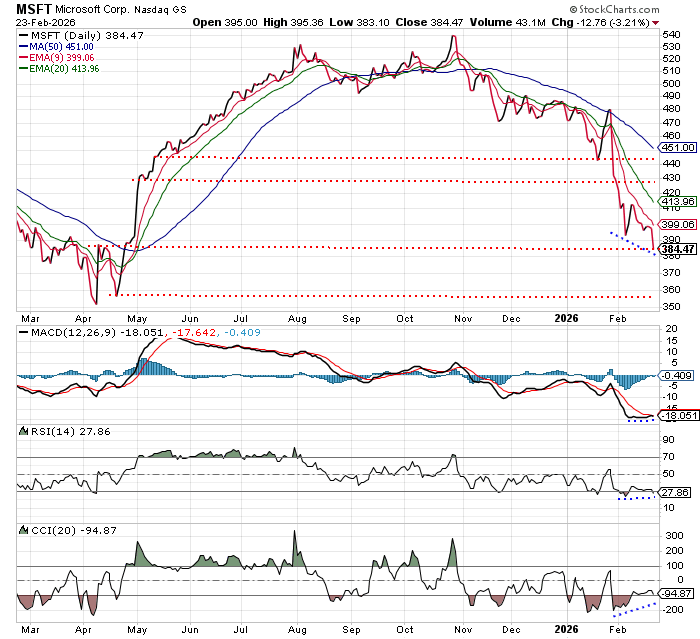
Here’s the updated chart…
Click here to view expanded chart
MSFT closed Monday right on support near $385 per share. That’s the line connecting the former resistance from last April – which is now support.
This current price is below the previous low set earlier this month. Notice, though, as the stock has made a lower low, the momentum indicators at the bottom of the chart are making higher lows.
This sort of “positive divergence” indicates the momentum behind the decline is waning. It’s an early warning sign of a potential rally.
This positive divergence did not exist two weeks ago. So, while we suspected MSFT could put on a quick bounce, we also suspected the stock was not yet ready to mount a sustainable rally. Any bounce from that condition was likely to be short-lived and MSFT would come back down to form a lower low.
That is exactly what has happened.
Now, though, with the positive divergence in place, we can be more confident in the prospects for an intermediate term rally. And, we can buy speculative calls.
Remember, though, options are designed to reduce risk. So, any trade we set up using options should limit our loss to less than what we’d be willing to lose on the stock itself.
For example, let’s say we’re willing to buy 100 shares of MSFT at $385 per share. That’s a total investment of $38,500. Let’s also say that we’re willing to risk a 10% move in the wrong direction. In other words, if MSFT falls $38.50 to $346.50 we’d cut our losses and stop out of the trade. So, we’re willing to risk $3,850 on this investment.
In order to reduce my risk, I’ll take something less than that $3,850 over to the option market and create a trade.
In fact, I’ll cut my risk by more than half and use just $1,800 on an option trade.
So, rather than putting up $38,500 to buy 100 shares of MSFT, I’ll put up just $1,800 to buy call options. The rest of the money can sit safely in cash in my brokerage account. Rather than risking a 10% loss on the stock – which is $3,850 – I’ll risk $1,800 on an option trade.
The MSFT March 20 $392.50 calls closed Monday at $8.75. For the sake of this example, and to make the math easier, let’s round that up to $9.00. We can buy two of these contracts for $1,800.
Rather than buying 100 shares of stock, the two call options give us exposure to 200 shares. So, we have the potential for a larger gain if MSFT rallies. And, we’ve limited our loss to less than half of what we were willing to risk on the stock.
My upside target for MSFT is the next resistance line near $430. If MSFT can get to that level by the expiration date of the options (March 20) then the option will be worth at least $37.50.
We paid $9 for each option. By selling them for $37.50 we’ll realize a gain of $2,850 per contract, or $5,700 on the total trade.
Alternatively, if we had purchased 100 shares of stock instead at $385 per share, we’d be up $45 per share, or $4,500 total.
By using call options instead of buying the stock, we’ll reduce our risk on the trade AND we’ll increase our profit potential.
This is the right way to trade options.
Best regards and good trading,

Jeff Clark
Editor, Market Minute