

Managing Editor’s Note: Today, we’re hearing from our contributing editor, Mike Burnick, in his weekly Thursday feature.
Mike brings 30 plus years of hands-on market experience – from trading floors and research desks to running his own mutual fund as a registered investment advisor – and now leads multiple TradeSmith advisories including Constant Cash Flow, Infinite Income Loop, and Inside TradeSmith.
Now, here’s Mike…
Key Indicators to Watch for This Rapid Reversal
BY MIKE BURNICK, CONTRIBUTING EDITOR, MARKET MINUTE
After tumbling 14 out of 21 trading days in March for a decline of 9.5%, the S&P 500 rapidly reversed, posting gains in 11 of the first 14 trading days of April, up 8.6%.
This sudden reversal of fortune left plenty of investors scratching their heads. And it’s reminiscent of the tariff-turmoil one year ago.
After the 2025 low, the S&P 500 went on to post big gains over the next six months.
But don’t expect a repeat performance this time around.
Let’s take a closer look at our Market Health outlook on the TradeSmith Dashboard page, and you’ll see what I mean.
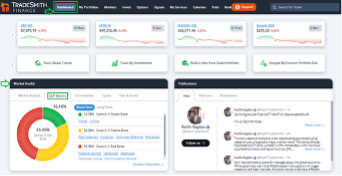
You can see the short-term Health distribution among S&P 500 sectors above at lower left. This view tells you our market outlook over the next few months.
Only Energy and Utilities are in the Health indicator green zone, which means they’re trending normally.
Most sectors are in the Health red zone, which means they’ve stopped out and are unhealthy to trade.
These sectors include Financial Services, Technology, Healthcare, Consumer Cyclical and Communications.
The remaining sectors are in no-man’s land in the Health yellow zone, including Basic Materials, Industrials, Consumer Defensive and Real Estate.
Sectors (or stocks) in the yellow zone have already declined half-way to the red zone, so proceed with caution.
If you switch to the long-term Market Health view, however, the picture looks better. This view tells you our outlook over the next 12 months or more.
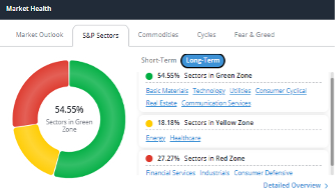
As you can see, the majority (54.55%) of sectors are Green. Two sectors, Energy and Healthcare are yellow.
Meanwhile, Financial Services, Industrials and Consumer Defensive are in the red zone.
This tells me at a glance that we may want avoid Financial and Healthcare stocks, since they’re the only sectors in the red zone both short- and long-term.
New buying opportunities should mainly be considered in healthy sectors, especially stocks in the green zone.
Yellow zone stocks can likewise be considered buy-the-dip opportunities, based on additional research.
Several sectors have already improved with the recent rally, bouncing back into the long-term Health green zone from yellow.
These include Basic Materials, Technology, Consumer Cyclical, Real Estate and Communications Services.
That’s positive for the stock market overall, because these five sectors combined account for nearly 60% of the S&P 500 by market cap.
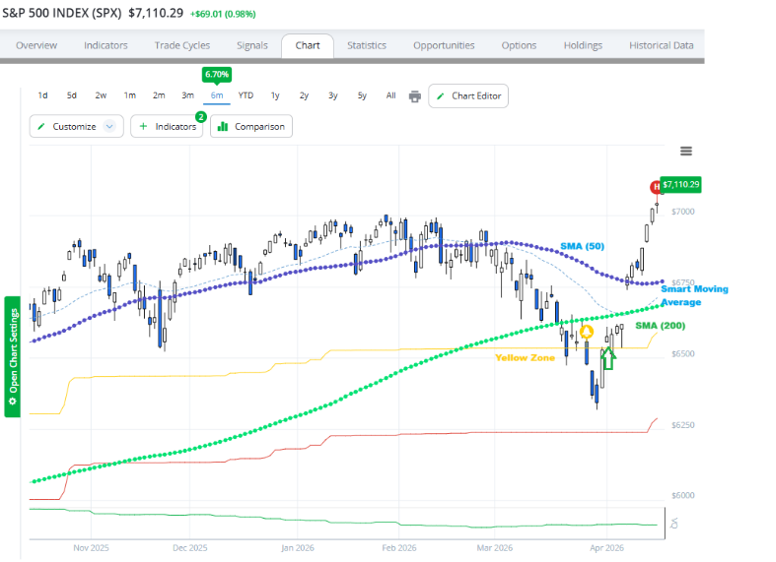
Looking at the long-term TradeSmith chart of the S&P 500 above, you can see how prices have surged back above our Smart Moving Average (SMA) of the index.
The Smart Moving Average is a proprietary indicator we developed that’s unique to every stock and index.
It isn’t a “static” moving average like the popular 50-day moving average. Instead, it’s based on the ever-changing volatility of underlying stocks.
So it better captures the true underlying trend of stocks, or the market index.
The next positive to watch for is for our SMA to rise back above the S&P 500 50-day moving average.
SMA is currently near 6,750 and rising a bit every day, while the 50-day average is near 6,780 and rising more slowly. So, not too much further to go.
The flipside, however is that if the SMA fails to move above the S&P’s 50-day average, or it cannot hold above this key trend level, stocks could be vulnerable to roll over again and pull back toward recent lows.
Stay tuned and keep a watchful eye on these TradeSmith market health and trend indicators.
Good investing,

Mike Burnick
Contributing Editor, Market Minute