
Managing Editor’s Note: On Wednesday, TradeSmith CEO Keith Kaplan showed the nearly 9,000 people who joined the AI Signals Trading Event how, in a five-year backtest, a model portfolio of signals trades delivered a 12x return.
And in 2022 – the worst year for stocks in half a century – they produced an average backtested gain of 16.6% while the S&P 500 fell nearly 20%.
He also shared two free recommendations: The No. 1 stock to buy right now and the No. 1 stock to avoid… along with a bonus options play designed to amplify the gain.
And in a TradeSmith first, lead developer Mike Carr placed a real-money trade on a stock he’d never even heard of – following nothing but the signal.
If you missed it, the replay is still online. It’s packed full of trade examples, strategy details, and on-screen demos
100x More Important Than the Strait of Hormuz
BY KEITH KAPLAN, CEO, TRADESMITH
The most important story in the world right now isn’t the Strait of Hormuz…
…or the price of oil…
…or the Epstein files.
It’s 100x more important than all of that.
It’s a crash program called Project Glasswing that brings together top finance officials from the federal government and the CEOs of some of America’s most powerful corporations.
What sparked it is a new frontier model called Mythos from Anthropic, the private firm behind Claude AI. By every measure, Mythos is the most capable AI model ever built – and what it can do is genuinely alarming.
It can read the source code of the software running your bank, your hospital, even your power grid… and find security flaws that human experts missed for decades.
As just one example, Mythos discovered a flaw in OpenBSD – a system that runs sensitive firewalls, government networks, and critical infrastructure – that its human developers had missed over 27 years of detailed security audits.
Then it wrote the code to exploit it… autonomously… on the first try.
As Anthropic put it in a press release on April 7, Mythos reveals a stark fact about the state of AI in 2026…
“AI models have reached a level of coding capability where they can surpass all but the most skilled humans at finding and exploiting software vulnerabilities.”
When Washington leaders caught wind of this, they knew they had to move quickly.
Treasury Secretary Scott Bessent and Fed Chair Jerome Powell summoned the CEOs of Citigroup, Morgan Stanley, Bank of America, Wells Fargo, and Goldman Sachs to the Treasury Building at 1500 Pennsylvania Avenue – steps away from the White House’s East Wing.
Anthropic announced Project Glasswing the same day. Eleven launch partners – Amazon, Apple, Google, Microsoft, JPMorgan Chase, Cisco, NVIDIA, Broadcom, CrowdStrike, Palo Alto Networks, and the Linux Foundation – would get early access to Mythos.
Anthropic committed up to $100 million in usage credits. The mission: find the flaws before someone else weaponized a model like this one.
This may sound like the plot of a Hollywood movie. But Glasswing is very real. And what it tells us about AI’s capabilities has implications that reach well beyond cybersecurity – into every portfolio in America.
Decoding the Market’s Hidden Structure
Mythos finds patterns in computer programs that no human could see.
It reads millions of lines of code, identifies the specific combinations of conditions that point to a vulnerability. Then it acts on them.
Look deep enough, and you’ll find that the stock market contains similar kinds of hidden structures. Buried inside decades of data for every stock are “signals” – specific combinations of conditions that have consistently preceded big moves.
Only for most of market history, they were invisible. The data existed… only nobody had the tools to read it.
But today, thanks to AI, it’s possible to find signals with historical accuracy rates of 90% or better.
I know because my team and I at TradeSmith have created a new AI-powered trading tool that’s unearthed 30,000 of these signals across nearly 2,500 stocks.
As I showed the nearly 9,000 people who joined my AI Signals Trading Event on Wednesday, in a five-year backtest, a model portfolio of these signals trades delivered a 12x return.
And in 2022 – the worst year for stocks in half a century – they produced an average backtested gain of 16.6% while the S&P 500 fell nearly 20%.
If you missed it, the replay is still online. It’s packed full of trade examples, strategy details, and on-screen demos. Go here to watch it now.
Today, I want to share something I didn’t have time to cover on Wednesday – how much work and ingenuity went into building our new system.
The answer is: more than I expected.
Can the Weather in Paris Move the Stock Market?
Our chief developer, Mike Carr, has been writing code for 40 years.
He spent 20 years in the U.S. Air Force – coding nuclear missile paths, working on cryptography for the National Security Agency, and helping install an early version of the internet at the Pentagon.
When he left the military, he went on to manage more than $200 million in client funds. He also became a Chartered Market Technician – a credential only about 4,500 people in the world hold.
Two years ago, he joined TradeSmith to help us develop new analytics and strategies. And he brought with him the kernel of an idea he’d been working on for more than 20 years.
In 2003, Mike started doing rudimentary signal studies. Every time he spotted a repeating pattern in the data that tended to precede a move in a stock – he noted it down. He traded this way for years, constantly testing what worked and what didn’t.
Then in 2016, he read a Bloomberg profile of Jim Simons’ storied hedge fund, Renaissance Technologies. One detail stuck with him: Simons had once found a tradable signal involving the weather in Paris.
If he could find a signal in Paris weather, Mike realized, the signals hiding in ordinary market data had to be almost limitless. That was the moment he decided to stop hunting for signals manually and start building a system that could hunt them at scale – one ordinary investors could actually use.
Last year, we started feeding the 150 or so signals he’d collected into an AI system and prompted it to generate more like them. We processed more than 1 trillion database rows, running every stock through 847 individual calculations. We tested every combination of price patterns, technical indicators, and calendar conditions we could find.
Then we hit a problem we hadn’t anticipated.
On any given day, our AI-powered signals generator was delivering a flood of 30,000 trade setups – all with historical accuracy rates of 75% or better. It was far too much for any trader to handle, no matter their level of experience.
So we spent the next six months solving a different problem: How do you take that many high-quality signals and deliver something an investor can actually use?
The answer Mike came up with was the Quality Score. It’s a 0-to-100 rating that factors each signal’s win rate and average returns and uses machine learning to figure out how effective it was during similar market conditions in the past.
Pair that with a focused model portfolio, and the flood became an actionable shortlist.
Introducing Our Three-Stock Strategy
At any given moment, it holds three S&P 500 stocks – each one selected by an algorithm based on its Quality Score and other key factors. When an exit signal fires on one of the three, a new trade recommendation takes its place.
That’s the whole strategy. Three positions, always live. Each one selected not because a human liked a chart or a story… but because an algorithm chose a mathematically optimal trade.
We backtested it from January 1, 2020 through January 30, 2026 – a stretch that covered the COVID crash, the 2022 bear market, two years of historic inflation, rising interest rates, and two wars.
It wasn’t a friendly period to stress-test a trading system against. But here’s what the Signals Master Portfolio produced:
- A 54% compounded annual return – versus about 15% for the S&P 500 over the same six years
- A 73.4% win rate across hundreds of trades
- A maximum drawdown of 18.1% – less than the S&P 500’s maximum drawdown of 25.4%
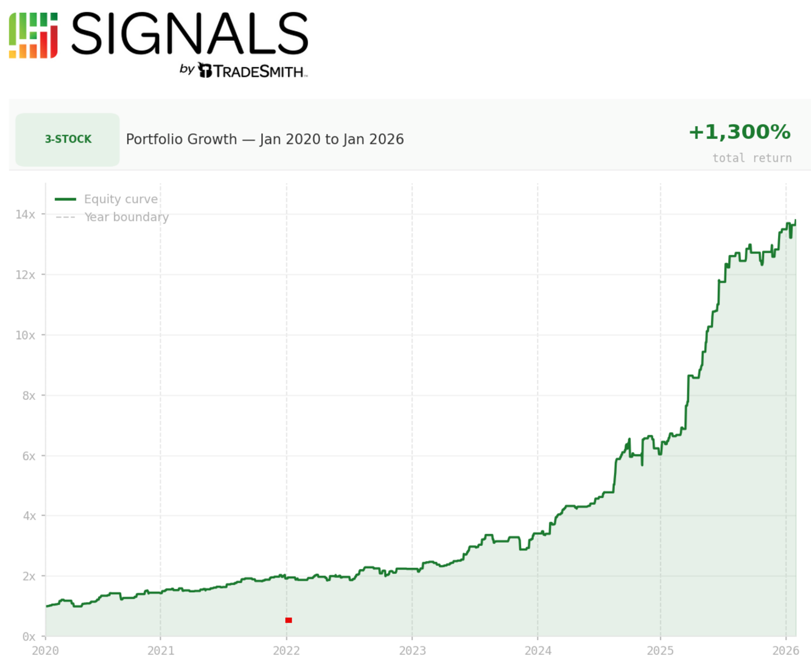
The model portfolio’s maximum drawdown is worth pausing on.
A lot of trading systems can generate a high compounded return in a backtest. Few can generate one that also held up better than a benchmark like the S&P 500 during its worst stretch. That’s the litmus test of whether a system is managing risk effectively or just riding luck.
Which is the point of what we’ve spent the last 12 years (and in Mike’s case more than 20 years) developing. Hedge funds have been doing this kind of work for decades – pattern recognition, machine learning, disciplined rotation in and out of short-term trades. But until now, nothing like it has existed for regular investors.
I went into all the details during Wednesday’s launch event. So if you haven’t already, make sure to check it out while it’s still online.
Keith Kaplan
CEO, TradeSmith