

Listen to the audio version of this article (generated by AI).
Jeff’s note: If you joined me for my 12 Trades to $1 Million Challenge event last Thursday, thank you! We got a fantastic response from Market Minute and TradeSmith readers.
I’m told 3,259 of you joined me to hear all about my first-ever trading challenge.
If you missed it, don’t worry. We’ll be accepting new participants until midnight ET tomorrow.
So, there’s still time to check out what’s it’s all about… and how we’ll attempt to trade our way to $1 million using my time-tested options strategy in 12 trades or less with just a small starting stake.
The Next “Rip Van Winkle” Trade
BY JEFF CLARK, EDITOR, MARKET MINUTE
Rip Van Winkle is getting a lot of action these days.
It used to be we’d get one “Rip Van Winkle trade” every two years or so. Now, though, they seem to come along about every three months.
These are trades where a stock or a sector has been so beaten down, so utterly demolished, so crushed to the point of absurdity that the laziest of traders need only buy the stock, or sector, and then go take a nap.
We’ll wake up several weeks later to a changed world.
The energy sector gave us a great Rip Van Winkle trade last November. Energy stocks lagged the broad stock market for all of 2025. By November, XLE – the energy sector ETF – was trading at its lowest relative value to the S&P 500 in over four years.
I suggested, at the time, that most energy stocks would be trading higher a few months later.
Sure enough, the energy sector went from being one of the worst-performing groups in 2025 to the best-performing sector for the first quarter of 2026. Folks who bought XLE in November 2025 could have taken a five-month nap and then woke up to 40% gains.
It was a similar story for the software sector earlier this year. In February we noted the software sector looked similar to how the energy sector looked in November. Software stocks had fallen so hard that the sector ETF (IGV) was trading at its lowest value – relative to the S&P 500 – in over five years.
Since then, IGV has gained 15% in three months. And, it looks like there’s still plenty more room for it to run higher. Folks who bought the software stocks in February might want to fall back to sleep for a bit.
Before we resume our nap, though, we might want to buy a few medical device stocks. You see, the medical device sector (IHI) looks the same today as the software sector did in February, and as the energy sector did in November.
Look at this ratio chart comparing the action in IHI to the action in the S&P 500…
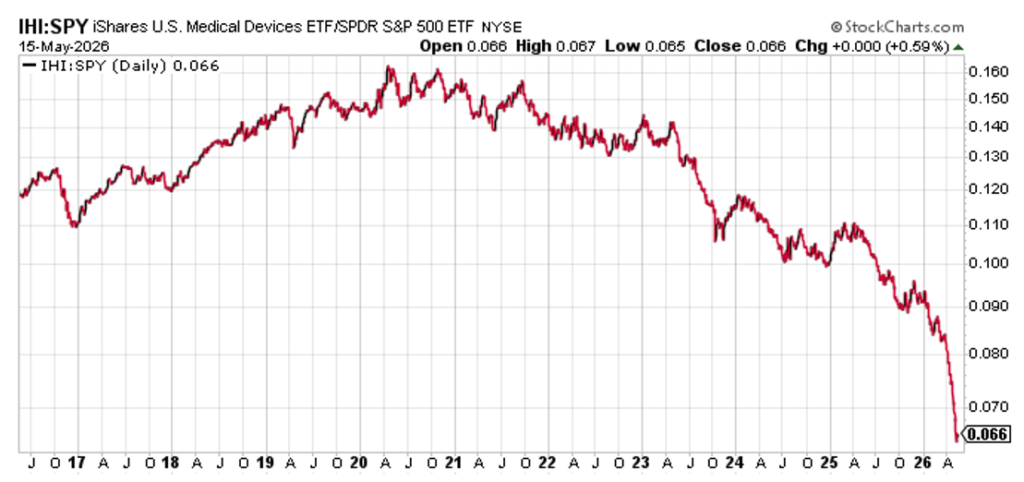
When this chart is moving higher, the medical device sector is outperforming the broad stock market. When this chart is declining, medical device stocks are underperforming.
Relative to the S&P 500, IHI is at its lowest level in the past 10 years. Or to put it another way… the medical device stocks are cheaper today than they have been at any time in the last 10 years.
Of course, that doesn’t mean the medical device sector has to rally from here, or that it can’t fall even further. But, if the main strategy of investing is to “buy low and sell high,” then buying into the medical device stocks at current levels meets the first criteria.
The proverbial “rubber band” for the sector is stretched quite far to the downside. It is set up for one heck of a “snap back” move.
The timing of that move is uncertain. But, the risk/reward setup is favorable enough to allow some patience for it to play out.
I suspect most medical device stocks will be trading higher a few months from now than where they are today. If you’re willing to buy into the sector, and then go take a Rip Van Winkle style nap, you should be pleasantly surprised when you wake up.
Best regards and good trading,

Jeff Clark
Editor, Market Minute