

Microsoft (MSFT) shareholders haven’t made any money over the past month. But, if you’ve taken the trades I suggested here in Market Minute, you’re sitting on nearly $3,000 in gains.
Today, we’ll look at how to manage that trade to further reduce your risk and keep the potential for larger gains if MSFT moves higher.
First, though, let’s review what we’ve done with MSFT so far…
Trading the Right Way
In last month’s video edition of Market Minute, MSFT was trading near $414 per share, and I explained why I thought it could decline towards $390 in the short-term. At that price, though, I would be willing to sell uncovered put options on MSFT – thereby generating income by merely agreeing to buy the stock at a depressed price.
Two days later we got the opportunity to do that. MSFT declined to $394 per share. Traders could have sold the MSFT February 13 $390 put option for $4, and collected $400 for each contract.
In my essay on February 10, we looked at why selling uncovered puts on MSFT was a better strategy than buying speculative call options. While MSFT was oversold enough to generate a bounce, it didn’t yet have the conditions in place to sustain a multi-session rally.
Sure enough, MSFT bounced – which allowed traders to profit when the February 13 $390 uncovered put option expired worthless. Then the stock headed back down to make a lower low. And this time, the chart of MSFT showed the sort of “positive divergence” that often leads to a rally.
And, on February 25 – with MSFT trading near $385 per share – we looked at how buying two MSFT March 20 $392.50 call options for $9 per contract would create a trade with less risk and more potential reward than buying 100 shares of the stock.
Last Friday, MSFT closed at $409 per share. The MSFT March 20 $392.50 calls closed at $21.75. Folks who bought the stock outright would have put up $38,500 to buy 100 shares. That trade is now worth $40,900 and is showing a gain of $2,400.
Here’s Why Options Are Better…
Traders who bought the calls, however, put up $1,800 to buy two contracts that are now worth $4,350. That’s a gain of $2,550.
This is an excellent, real-time example of how option strategies can generate larger profits with less risk than buying shares of stock.
Now, let’s discuss what to do now…
Remember, the true purpose of using options is to reduce risk. Traders should evaluate their positions with that goal in mind. So, I’m always looking for chances to lessen my exposure to a trade.
One of the trading rules that helps me do that is to always sell half of a speculative option position once I’ve earned 100% on the trade. By selling half the trade at a double, I can take my original capital off the table, and eliminate the possibility of taking a loss. Then I can hold the balance of the position in anticipation of larger gains.
In this example with Microsoft (MSFT), we would have sold one of the two calls we purchased as soon as it traded at $18. That puts the original $1,800 we spent on the trade back in our pockets. Now it’s impossible for us to lose any money on the trade. And now, we can ride the MSFT rally for as high as the stock can go.
Here’s an updated look at MSFT…
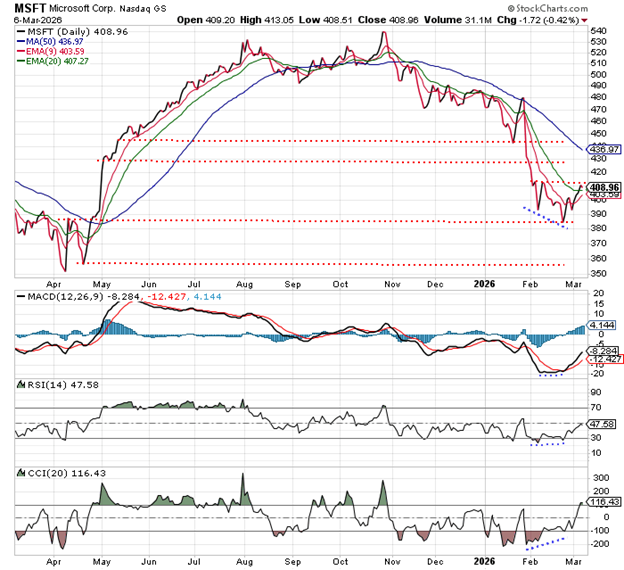
You can see how MSFT bounced right off the support line we identified back on February 25. Since then, the stock has made a series of higher highs and higher lows.
That’s bullish. It suggests MSFT has started in intermediate-term rally. And, the 50-day moving average (MA) line near $437 remains a viable upside target.
For the very short-term though, MSFT is bumping up against the resistance of its February high. It’s reasonable to expect a brief pullback from here.
The 9-day and 20-day exponential moving averages (EMA) – which are the squiggly red and green lines on the chart – should provide support.
So, as long as MSFT doesn’t close below its 9-day EMA at $403.59, the setup remains bullish and traders should expect higher prices.
On the other hand, if MSFT closes below its 9-day EMA, then the momentum will shift back into the bearish camp.
In that case, traders should take profits on the remaining MSFT call option, move to the sidelines, and wait for another opportunity to re-enter a similar position.
Best regards and good trading,

Jeff Clark
Editor, Market Minute
P.S. This is how I use options to reduce risk and increase reward. It’s the right way to trade with options.
I give my entry-level subscribers opportunities like this at least once a month… with in-depth instructions, a full 8-video master course on how to options trade, and more. If you’re interested in more opportunities to safely play companies like Microsoft – especially in this market environment – check out Jeff Clark Trader right here.