

He couldn’t be leaving at a better time… for him.
Today is Jerome Powell’s last press conference as Chairman of the Federal Reserve Board. As he heads out the door, we’ll note that short-term interest rates are low. The stock market is at an all-time high. The unemployment rate is at 4.3% – which is considered “full employment.”
And, if you believe the government’s numbers, inflation is running at about 3%.
By most measures, Mr. Powell can walk off into the sunset, basking in the glow of a job well done. What many folks may not appreciate, though, is that “glow” is coming from the lit fuse of a financial bomb that will likely go off sometime in the near future.
Look at this chart of the 30-year Treasury Bond Yield…
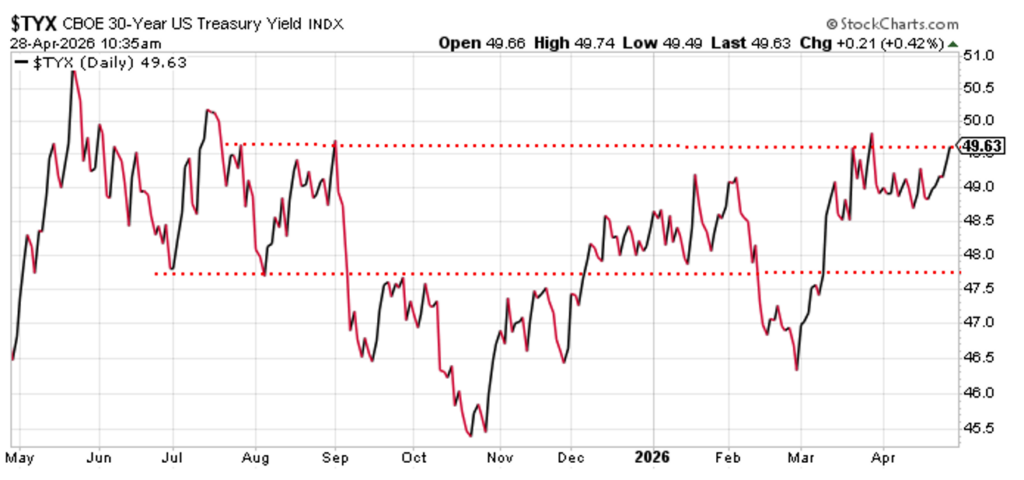
The last time we looked at this chart was back on December 2, 2025. We noted the inverse head-and-shoulders pattern – which, if it played out, would target a rate of 4.95%.
The 30-year yield hit that target last month, and then pulled back. Over the past few weeks, though, yields have been grinding higher. Now, TYX looks like it’s poised to break out above the 5% level that many bond analysts describe as the “breaking point” for the bond market.
The bond market sees financial stress on the horizon – something stock investors haven’t noticed yet. Or, if they have noticed it, they’re not concerned by it. But, they should be.
Rising interest rates are a headwind for the broad stock market. They increase the cost of corporate borrowing. And, they increase the cost of consumer financing. These factors combine to put pressure on corporate earnings and consumer demand.
What’s worse is that these higher long-term rates are happening at a time when the US needs to borrow more money than ever.
Consider this…
$9.7 trillion in Treasury debt comes due in 2026. That amount will have to be refinanced, along with an additional $2 trillion in new debt in order to fund this year’s deficit.
The cost of existing Treasury debt is about 3.65%. But, with long-term rates currently approaching 5%, that cost is about to go up – a lot.
During previous economic challenges the Fed would step up and purchase bonds from the Treasury – thereby providing demand to meet the supply of new debt. For example, during the Covid crisis, Chairman Powell instructed the FOMC to buy bonds – which increased the Fed’s balance sheet from $4 trillion to over $9 trillion.
That balance has never been worked off.
Despite Mr. Powell often talking about the importance of shrinking the balance sheet during good economic times, Chairman Powell is leaving the Fed with the most bloated balance sheet ever. There’s not much room for a new Chairman to maneuver if the economy turns south.
The bond market is worried. That’s what the rising 30-year yield is telling us. If the yield presses much higher, the stock market will get worried, too.
So… like I said… Mr. Powell is leaving the Fed at a pretty good time… for him.
Best regards and good trading,

Jeff Clark
Editor, Market Minute