
Listen to the audio version of this article (generated by AI).
Managing Editor’s note: Our colleagues Andy and Landon Swan have spent 25 years building a system that tracks consumer behavior across social media posts, search trends, and web traffic to spot market winners early.
That edge has produced more than 30 triple-digit wins for subscribers over the past five years, including a 461% gain on Oklo and a 556% gain on Robinhood.
That’s what each monthly MegaTrends report does. The Swan brothers look for a shift in what people and companies are spending on – then find the strongest companies feeding it before that spending shows up in the stock price. Check out the latest stock flashing on their system…
Elon Musk is so starved for electricity that he’s trucking dozens of gas turbines onto a lot outside Memphis and firing them up himself.
His AI burns through power faster than the grid can deliver it. So SpaceX (SPCX) is spending $2.8 billion on gas turbines, roughly $2 billion of it on mobile units that fire up in weeks instead of the years a real plant takes.
The data center they feed, called Colossus, already draws about a gigawatt – the same as a good-sized city. And SpaceX is building a permanent 1.2-gigawatt plant on top of that, just to keep the servers running.
Musk is far from alone. Across the country, the biggest names in tech are grabbing every watt they can get their hands on. Microsoft (MSFT) cut a deal to reopen Three Mile Island – the site of America’s worst nuclear meltdown – just to feed its AI. The International Energy Agency (IEA) expects global data-center electricity use to double by 2030, to roughly what all of Japan burns in a year.
Here in the U.S., data centers will drive close to half of the entire growth in electricity demand between now and then.
The machines that turn gas into that power are already spoken for. GE Vernova (GEV), the biggest turbine maker, told investors this summer it’s mostly sold out through 2030 – a 116-gigawatt backlog, with orders up 134% in a single quarter. Order a turbine today, and you could wait until the end of the decade to switch it on.
That’s why Musk is trucking in mobile units instead of waiting in line and why a new power plant costs 66% more than it did a year ago.
The plants already up and running just became some of the most valuable machines in the country. Whoever owns one is holding exactly what the richest companies on earth are scrambling for and can’t get fast enough.
This is the kind of gap MegaTrends is built to find. We track what people and companies are really spending on, then hunt for the companies feeding that demand whose stock price hasn’t caught up. Sometimes the two line up. Here, they’ve split wide open.
Because while demand goes vertical, the companies that own America’s power plants still trade below where they sat a year ago. Vistra (VST), down 28%. NRG Energy (NRG), off 22%.
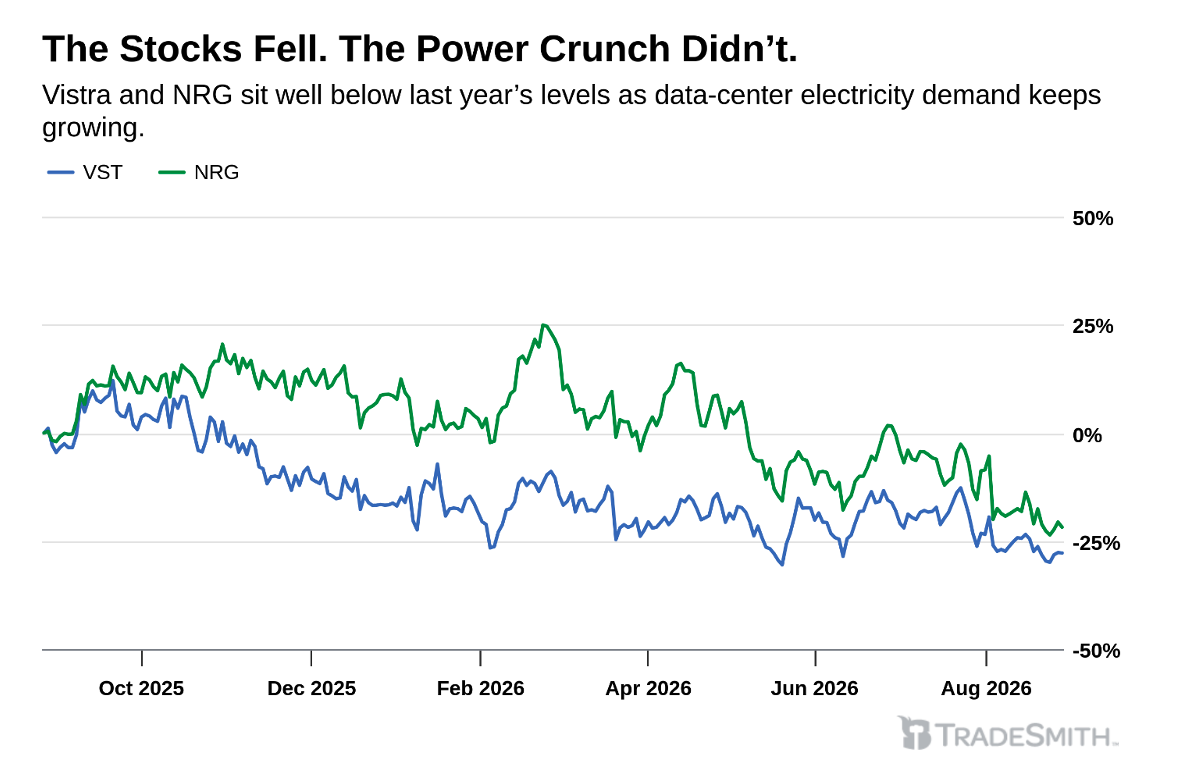
There’s reason for that. Power stocks doubled and tripled through 2024 and 2025, so this year opened with profit-taking. Then came the bigger worry: that AI companies are spending faster than profits can follow, and that the plants feeding them fall furthest if the spending slows.
But so far, every estimate about AI has proven too low.
The five biggest AI builders spent about $445 billion on data centers in 2025. Plans for 2026 top $600 billion, and two of them raised their budgets again in July.
Just look at Google (GOOGL). Its AI systems handled seven times more work this May than a year earlier, and every one of those requests burns electricity. Companies do not cut power orders while their machines run seven times harder. Chips get more efficient every year. Companies just run more AI with the savings, and power demand grows with it.
We’ve Seen This Movie Before
Last August, we told our MegaTrends members that AI runs on electricity, handing them a report of power names to buy early. One of them, Bloom Energy (BE), has climbed more than 300% since.
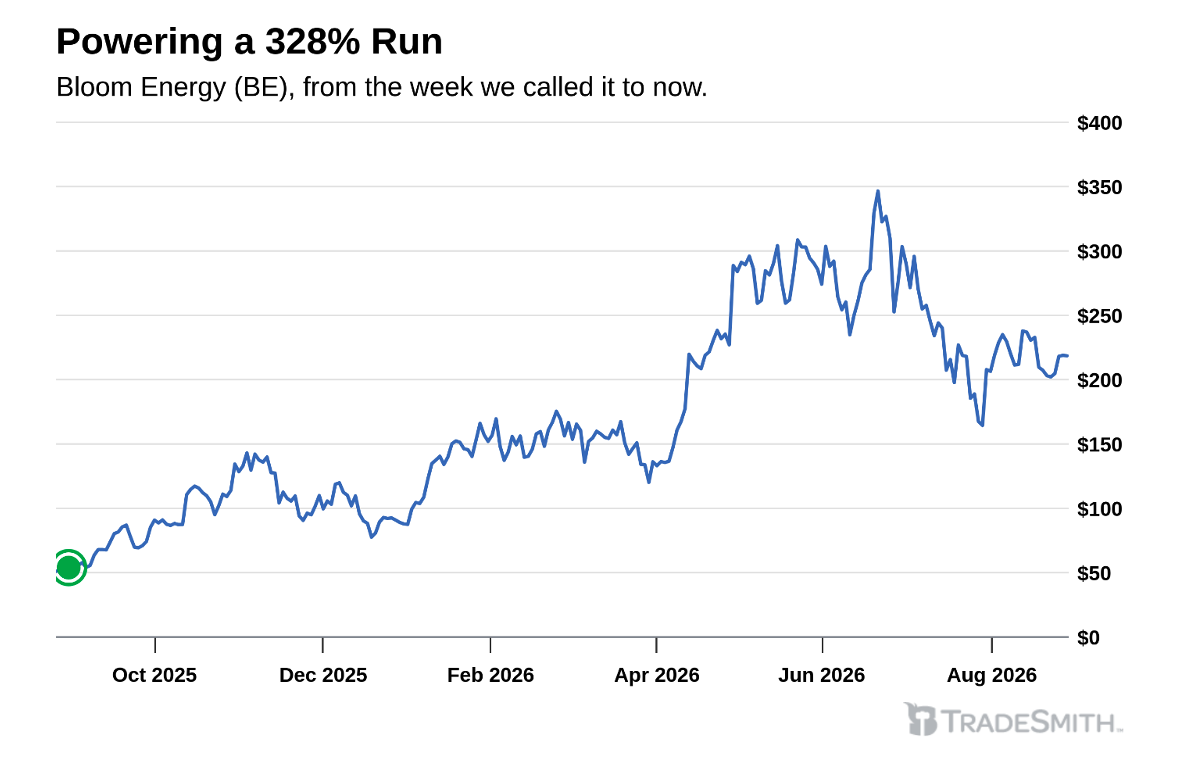
That wasn’t a lucky guess. Every month, our MegaTrends report adds new names to a watchlist we’ve been building since 2023 – more than 100 picks in all. We went back and graded every one. Nearly 6 in 10 turned into winners, and the average winner climbed 86%. The picks that kept paying, month after month, were the ones tied to real demand from customers who don’t disappear.
Power is about as real as demand gets.
So which company stands to gain most from a shortage this big?
One name our data keeps surfacing is the company behind that Three Mile Island deal from the top – helping Microsoft reopen America’s most infamous nuclear site.
This nuclear company is bigger and stronger than it was a year ago. Its stock is cheaper anyway. That gap is the whole reason we’re writing to you today.
The Nuclear Giant the Crowd Left Behind
Nuclear plants have one advantage no other power source has: they almost never stop. A single reactor runs at full power for a year or more before it needs refueling, whatever the weather. Solar shuts off at night and wind depends on a breeze, but a nuclear plant just keeps going.
That steady output is exactly what an AI data center needs. These buildings never sleep. The chips inside pull the same massive load at 3 a.m. as they do at noon, every day of the year. Power that quits at sundown can’t feed them.
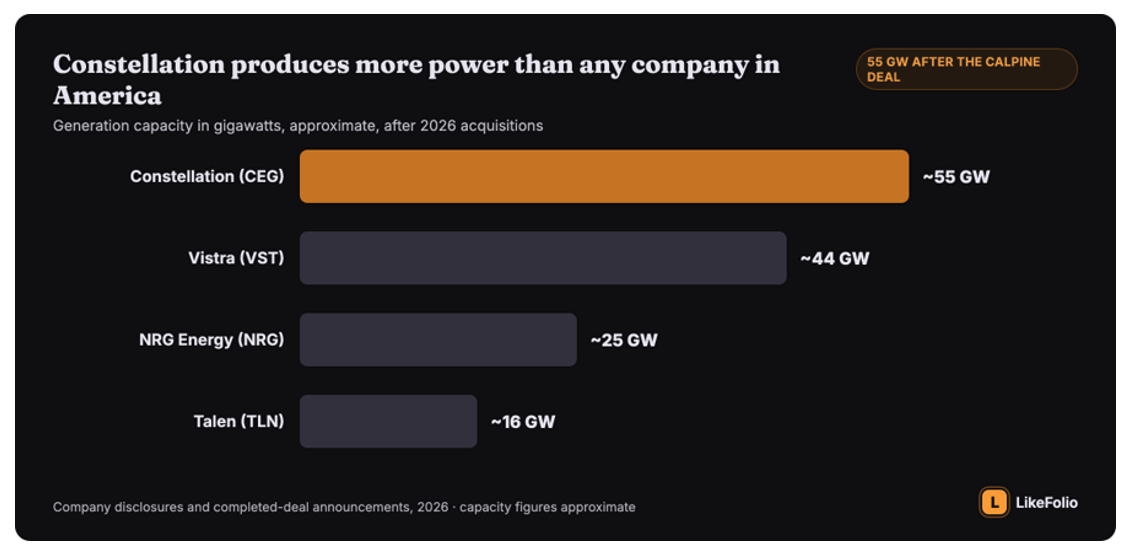
Constellation Energy (CEG) runs the largest nuclear fleet in America.
It sells around-the-clock power to utilities, factories, and increasingly the tech giants building AI.
And this year it got even bigger. A $22 billion deal for Calpine added the country’s biggest fleet of natural-gas plants on top of its reactors, making Constellation the largest power producer in America.
That’s why Microsoft called. It wanted Three Mile Island.
Constellation is bringing that reactor back online a year ahead of schedule – 2027 instead of 2028 – with a $1 billion federal loan behind it.
The rest of the business is moving just as fast. On its Aug. 6 earnings call, Constellation raised its full-year profit outlook and added 920 megawatts of new nuclear agreements that run 18.5 years on average. In the same quarter, the restart cleared its two big regulatory gates: Regulators approved the fuel license and the grid rights that let the power reach Microsoft.
Microsoft signed a 20-year deal for that power, starting on the day the plant comes online, now targeted for the second half of 2027.
Even after all of that, Constellation trades about 13% below where it sat a year ago, dragged down with the rest of the energy sector.
Power stocks trade with AI sentiment, and when doubt about AI spending flared, investors took profits in the group’s biggest winner first.
The selling this year was never about Constellation, and our Social Heat Score confirms it. The score reads millions of real consumer signals – social posts, searches, web traffic, even AI queries – and boils them into one number from 0 to 100. Anything above 60 is bullish. Constellation sits at 70.
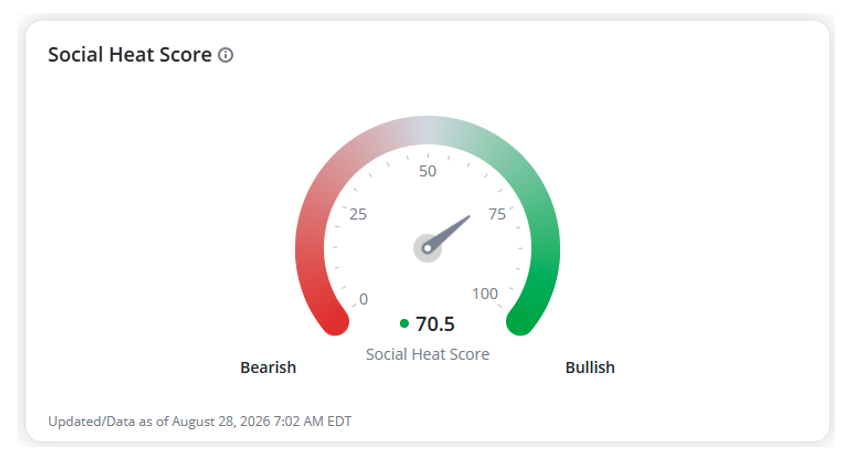
The opportunity is still open. We flagged Constellation to MegaTrends members in our March 2025 nuclear report, and it ran 84% by last fall. Now the same setup is back.
Constellation Is One Name. The Shortage Is Bigger.
On Aug. 20, MegaTrends members got the full report behind this “Power Grab” trend.
Next to a fresh read on Constellation, we handed them four more ways to play the same squeeze: the turbine maker every new plant now waits years for, two more plant owners on sale, and one small, aggressive bet tied to the very turbines Musk trucked into Memphis.
That’s what each monthly MegaTrends report does. We look for a shift in what people and companies are spending on – this time, the scramble for electricity – then find the strongest companies feeding it before that spending shows up in the stock price.
New names go on our watchlist. We track them there, and members hear from us the moment it’s time to buy.
All four of this month’s picks are flashing bullish on our Social Heat Score.
Paid-up members can read the full Power Grab report here – and track every ticker’s Social Heat Score on your TradeSmith Finance dashboard.
The crowd is looking the other way, and that’s usually when we do our best work.
Until next time,
Andy Swan
Founder, LikeFolio