
Listen to the audio version of this article (generated by AI).
President Trump needs long-term interest rates to fall.
Lower interest rates make it easier to refinance the mountain of Treasury debt coming due over the next few months. It makes it less expensive to finance the budget deficit. And, lower long-term interest rates will help ease the “affordability crisis” so many Americans are experiencing – which is making it difficult to buy a house, car, and any other long-term asset.
With the midterm elections coming up in November, if long-term rates fall between now and then it will increase the odds of the Republicans maintaining control of the House of Representatives and the Senate.
The Federal Reserve Board can’t do it.
The Fed controls the target for the short-term Fed funds rate. It has no control over long-term rates. In fact, when Chairman Powell lowered the Fed funds rate last December, it had the opposite effect on long-term rates.
The 30-year T-bond yielded 4.85% last December. It yields 5.27% today.
So, like I said, the Federal Reserve Board can’t do anything to lower long-term rates. That is the job of the free market – though, apparently with a little help from the US Treasury.
The Treasury issues and redeems long-term bonds. On Tuesday we discussed the enormous supply of bonds that is coming to the market over the next few months, and the problems with the lower demand for those bonds.
The market is anticipating that supply/demand imbalance and has already increased interest rates to account for it.
The Treasury can’t do anything about the supply side of the equation. They need to issue the bonds, and there’s no getting around that. So, the only way to bring long-term rates down is to somehow motivate investors to buy the bonds – in other words, increase the demand.
How do they do that? They buy the Japanese Yen.
By buying the yen, the U.S. government will make other, riskier assets less attractive and investors will seek the perceived safety of U.S. Treasury Bonds.
Think about this for a moment…
Last Thursday, the Japanese government announced it was intervening in the currency market to support the yen. That makes sense. Governments often step up to support their own currency when it has fallen too far too fast. The yen spiked higher on the news.
On Friday, Treasury Secretary Scott Bessent announced the U.S. Treasury was also intervening to help support the yen.
That’s odd. Governments don’t often step up to support another government’s currency. Indeed, the last time the U.S. Treasury bought the yen was back in 2011 – when Japan was hit with a tsunami, and several governments intervened to prevent a currency crisis.
Bessent’s announcement on Friday was a sharp departure from his stance back in January when he stated the U.S. Treasury would “absolutely not” intervene to support the yen.
So, why now? Why is the U.S. Treasury buying the yen for the first time in 15 years?
My guess is the U.S. needs lower long-term interest rates. The only way to do that is to generate a rally in Treasury bonds. And, the most practical way to do that is to inspire a rally in the Japanese yen – thereby wreaking havoc on the yen-carry-trade.
For the past several years, the most popular trade on the planet has been to short the Japanese yen and put the proceeds into the hottest stocks in the U.S. stock market. As the yen declines, traders profit on the short side of the trade. And, as the stocks rally, traders profit on the long side.
The yen-carry-trade has been wildly profitable for most of the past several years. There has, however, been a few brief periods where the trade came under pressure as the yen rallied and stocks corrected.
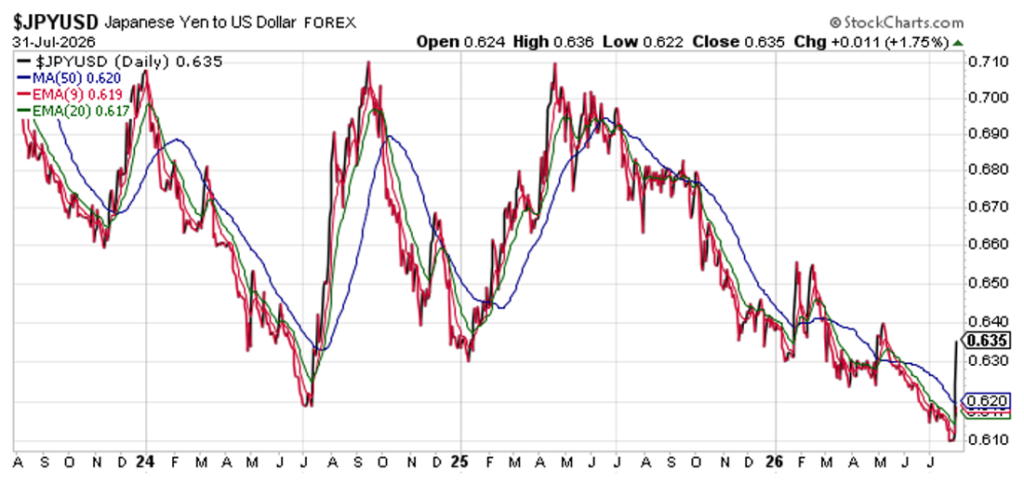
For example, from July through August 2024, the yen rallied 18% and the S&P 500 fell 10%. In 2025, from January through April, the yen rallied 13% while the S&P 500 dropped nearly 20%.
This happens as traders unwind their exposure to the yen-carry-trade. They close the short side of the trade by buying the yen, and they close the long side of the trade by selling stocks.
The interesting thing to note, and the premise behind this theory, is Treasury bonds rally along with the yen. In fact, there is a remarkably strong correlation between the price action in the yen and the price action in TLT.
Look at these charts of the yen…
And TLT…
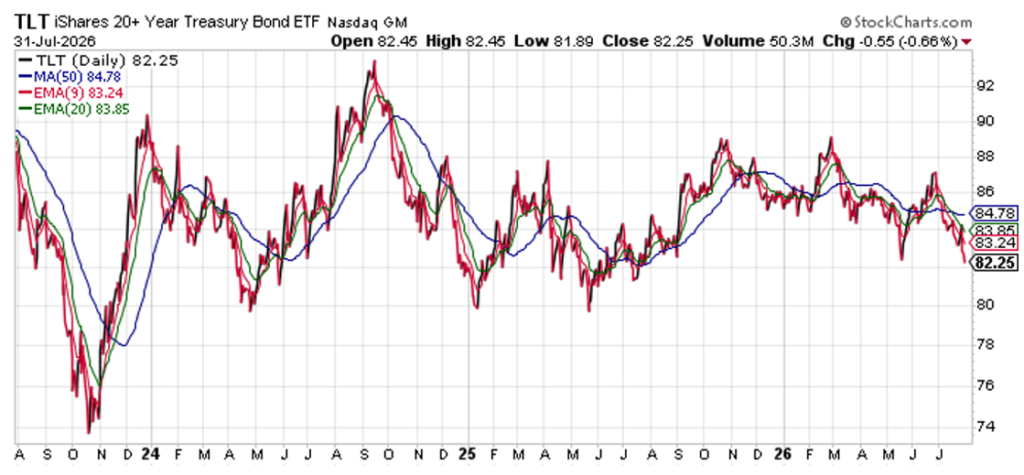
Notice the big rally in TLT in July and August 2024 – while the yen rallied. Notice also the 10% rally in TLT from January through April last year – while the yen rallied.
This happened as the unwinding of the yen-carry-trade caused stocks to sell off and investors ran for the safety of Treasury bonds.
So… if you want long-term interest rates to fall, in order to refinance debt at a lower rate and to increase the chances of winning mid-term elections, then you create a rally in the Japanese yen.
That’s why the U.S. Treasury is buying the yen. And, that’s why T-bond prices are likely to be higher several weeks from now than where they are today.
Best regards and good trading,

Jeff Clark
Editor, Market Minute