

Managing Editor’s Note: Today, we’re hearing from our contributing editor, Mike Burnick, in his weekly Thursday feature.
Mike brings 30 plus years of hands-on market experience – from trading floors and research desks to running his own mutual fund as a registered investment advisor – and now leads multiple TradeSmith advisories including Constant Cash Flow, Infinite Income Loop, and Inside TradeSmith.
Now, here’s Mike…
Liquidity Bust Could Lead to a Double Dip for Stocks
BY MIKE BURNICK, CONTRIBUTING EDITOR, MARKET MINUTE
That was fast.
Stocks surged higher once the calendar turned to April, with the Nasdaq 100 Index moving up 10 days straight for a gain of 13.2% off the March 30 low.
But it may not last.
As oversold as stocks were on March 30, the market is nearly as overbought today.
The S&P 500 Relative Strength Index (RSI) for instance, a great measure of a market’s momentum, traveled from under 30 just three weeks ago (oversold) to near 70 today.
That’s right on the doorstep of an overbought market.
Also, the percentage of S&P 500 stocks above the 20-day moving average skyrocketed above 70% this week from just 20% three weeks ago.
So, if you took my advice to buy quality stocks on the dip, now is the time to consider taking at least some partial profits.
That’s because two seasonal factors are now converging that could lead to another dip.
First, the month of April is generally kind to the stock market. The S&P 500 is up 63% of the time this month over the past 90+ years.
In fact, April’s win-rate is second only to December’s 71%.
But dig deeper and you’ll see that April’s stock market performance is front-end loaded.
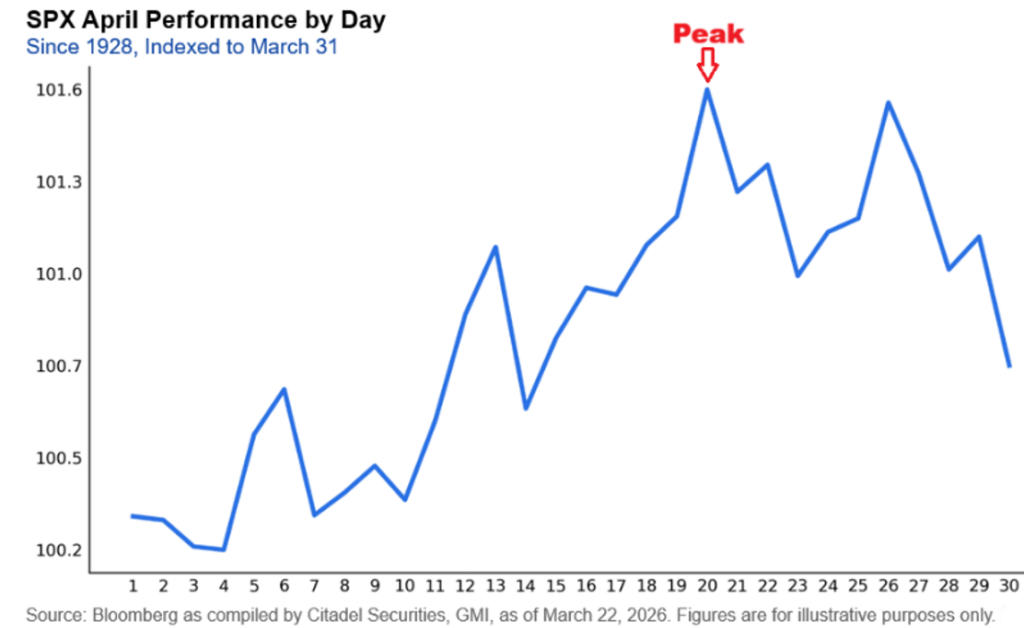
Stocks perform well in the first half of April, but typically peak in the third week of the month and decline into month end.
Typically, taxpayers who expect IRS refunds have an incentive to file their taxes early to receive a refund check sooner.
While those taxpayers who expect to owe money wait until the deadline to file.
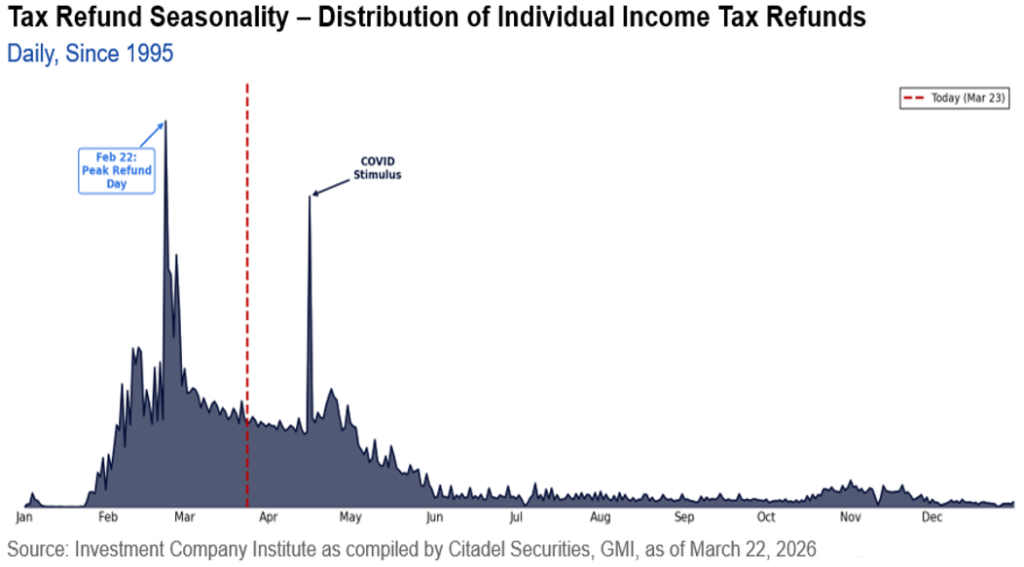
Historically, this leads to an early spike in tax refunds, which typically peak around the end of February.
In other words, the liquidity boost around tax refunds, which often find their way in financial markets, is largely over. And now we may see a liquidity bust.
Non-withheld tax payments are set to drain more than $500 billion from the banking system over the next few weeks, according to data from Strategas Research.
Second, this pattern is fueled in part by the timing of tax refunds around April 15th.
That lack of liquidity may not be enough to completely reverse the three-week stock market rally. But it could be enough to produce another buyable dip in stocks.
That’s especially true considering the still highly fragile ceasefire with Iran and oil prices still 50% higher than before the conflict began.
Mike Burnick’s Bottom Line: Stocks produced a nice bounce from very oversold levels as expected. Now comes a potential retest. The upside gap in the S&P 500 cash index at 6,700 looks like an enticing target for a pullback.